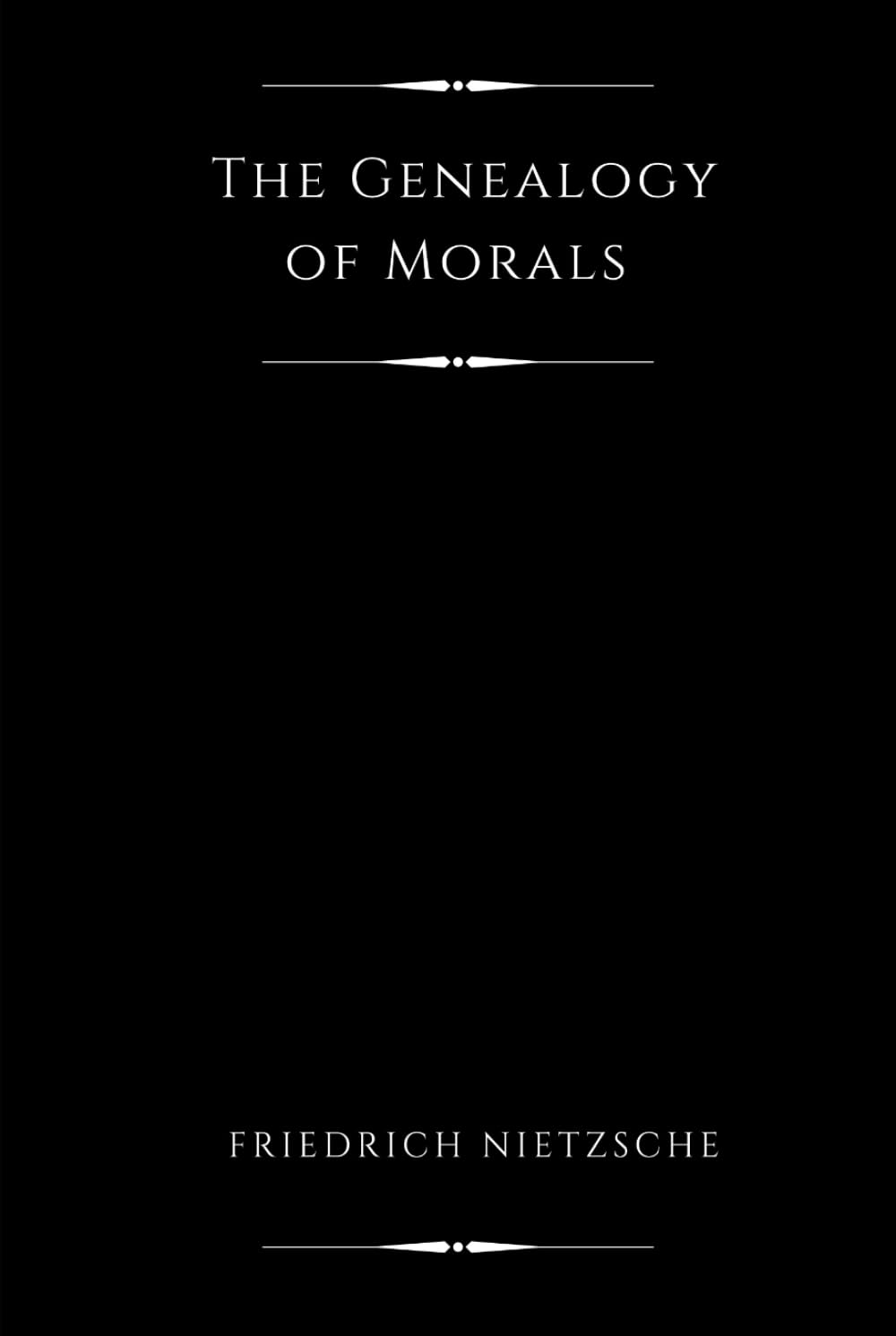
The Genealogy Of Morals
Caution: Heavy Lifting Ahead
This being the second book I have read from Nietzsche, I will start by stating that this is not light reading which I’m finding par for the course with the author. In fact, I feel as if I read the book twice being that I was frequently having to go back and reread entire sections to grasp the bigger picture Nietzsche paints. Further, with such an extensive vocabulary and often mixing in German, Greek, French, Latin, etc., forced me to often stop, look up the word, and then reread the sentence/paragraph with the context of the word to gain an understanding.
Further, I supplemented this book with a number of lectures about the book on YouTube. I will admit that I was flattered to find a few lectures that drove key points that I personally took away, or to find the speaker quoting the same quotes that I personally highlighted and extracted to my notes – Pat on the back Greg! But seriously, it's a compelling read that takes the reader through a historical journey while considering the origins of morality.
Morality as Point of View
Nietzsche doesn’t take morality at face value. Instead of seeing it as something eternal or handed down from the Gods, he views it as something that has evolved and continues to evolve over time. His essays explore the opposition between what he refers to as the bold “master morality” rooted in strength and vitality, and the reactive “slave morality” born out of resentment and humility. He argues that what we call “good” and “evil”, both originate out of this dichotomy and that our morals may be more self-serving in their origins than we think.
As an example, the aristocrats of “high society” with money and power would deep themselves as good, further their actions as good. After all, it would be their actions which would sustain the “good” life they lived. To the contrary, those of lower status would grow to resent those with power and the actions taken by them which they believe kept them at their low status in society. As such, it would only make sense from their point of view that those of “high society” were in fact “bad” along with their actions. This would eventually lead to the idea of refraining from such luxuries and practices and the development of ascetic ideals.
Origins of Guilt
Something I found intriguing within the book was his take on guilt and conscience. Nietzsche illustrates that when people could no longer express their instincts freely – aggressive and cunning traits that our hunting ancestry benefited from – that energy didn’t just disappear, it turned inward. The result? Guilt, self-punishment, and what Nietzsche calls the “bad conscience.” It’s basically the idea that what we bottle up will always find a way out, even if it means turning against ourselves. I can’t help but wonder how much influence this had on Jung’s concept of the shadow. In any case, it’s a reminder of how much healthier it is to channel our energy outward into creativity, courage, and purpose, rather than letting it eat away inside.
A few of my favorite quotes from the book!
Where your treasure is, there will your heart be also.Friedrich Nietzsche : The Genealogy Of Morals
Sacrifice what is desirable to what is true.Friedrich Nietzsche : The Genealogy Of Morals
Altruistic acts, simply because, as a sheer matter of habit, they were praised as good, came also to be felt as good.Friedrich Nietzsche : The Genealogy Of Morals
The judgement “good” did not originate among those to whom goodness was shown. Much rather has it been the good themselves, that is, the aristocratic, the powerful, the high-stationed, the high-minded, who have felt that they themselves were good, and that their actions were good.Friedrich Nietzsche : The Genealogy Of Morals
It is not surprising that the lambs should bear a grudge against the great birds of prey, but that is no reason for blaming the great birds of prey for taking the little lambs.Friedrich Nietzsche : The Genealogy Of Morals
In gauging values, the good of the majority and the good of the minority are opposed standpoints.Friedrich Nietzsche : The Genealogy Of Morals
How much blood and cruelty is the foundation of all “good things”!Friedrich Nietzsche : The Genealogy Of Morals
Why can suffering be a compensation for “owing”?Friedrich Nietzsche : The Genealogy Of Morals
Even the justest individual only requires a little dose of hostility, malice, or innuendo to drive the blood into this brain and the fairness from it.Friedrich Nietzsche : The Genealogy Of Morals
All instincts which do not find a vent without, turn inwards.Friedrich Nietzsche : The Genealogy Of Morals
The higher must not degrade itself to be the tool of the lower.Friedrich Nietzsche : The Genealogy Of Morals
His problem was not suffering itself, but the lack of an answer to that crying question, “To what purpose do we suffer?” Man, the bravest animal and the one most injured to suffering, does not repudiate suffering in itself, he wills it, he even seeks it out, provided that he is shown a meaning for it, a purpose of suffering.Friedrich Nietzsche : The Genealogy Of Morals
Get it today on Amazon!
Check out these other great books!

A Man’s Guide on How to Save Your Marriage
Without Having to Talk About ItDiscover what it means to be a "Powerful Man". To embody your masculine energy, take on the alpha role in your relationship, & take ownership over your actions.
The Seven Principles for Making Marriage Work
A Practical Guide from the Country's Foremost Relationship ExpertWhat makes marriages work? Discover the "lab grown" principles from Dr. John Gottman and learn why unresolvable problems aren't necessarily the biggest issue.

Can’t Hurt Me
Master Your Mind And Defy The OddsExplore mental toughness, discipline, and the power of pushing beyond limits through the life story of Navy Seal and ultra endurance athlete David Goggins.

100M Offers
How to make offers so good people feel stupid saying noFrom hitting a ceiling to building scalable offers, Hormozi turned struggle into a blueprint. This book gives you the system without the pain.